The development: credential standards are moving, but an admission decision still needs context
W3C published a Working Draft of Verifiable Credentials Data Model v2.1 on 30 September 2026. It describes a model for exchanging issuer claims through an ecosystem of issuers, holders and verifiers. Version 2.1 remains work in progress; it is not a new final Recommendation. The preceding v2.0 specification is identified by W3C as a Recommendation dated 15 May 2025. These statuses matter when education providers choose what to implement and what to monitor. Source: dated W3C v2.1 draft.
The practical distinction is equally important: checking that a credential is authentic does not automatically prove that every claim is true or that the credential meets a particular institution’s requirements. A receiving organization still applies its own trust and acceptance policy. Source: W3C verification and validation discussion.
For universities, training providers and education software teams, the opportunity is to make those decisions explainable. A signed document should enter a controlled review workflow, not become an unexplained green tick in an admissions screen.
What does this mean for education and workforce learning?
A learner applies for a program that requires a particular prerequisite. Their digital credential may come from a familiar institution, a newly approved partner, or an issuer outside the program’s accepted list. Even when the technical verification succeeds, the admissions team still needs to know what qualification was asserted, which policy applies and whether the evidence is sufficient for this application.
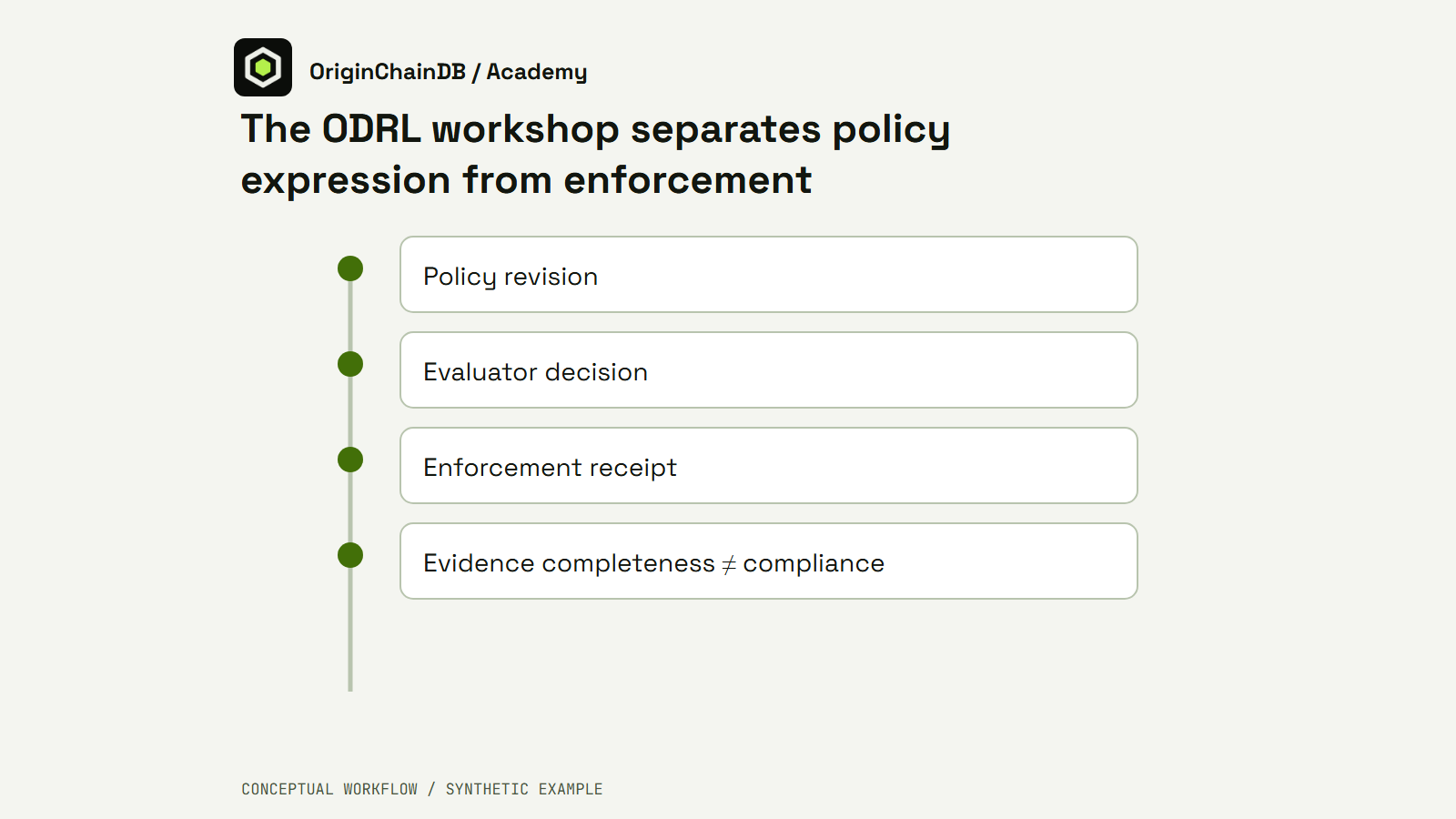
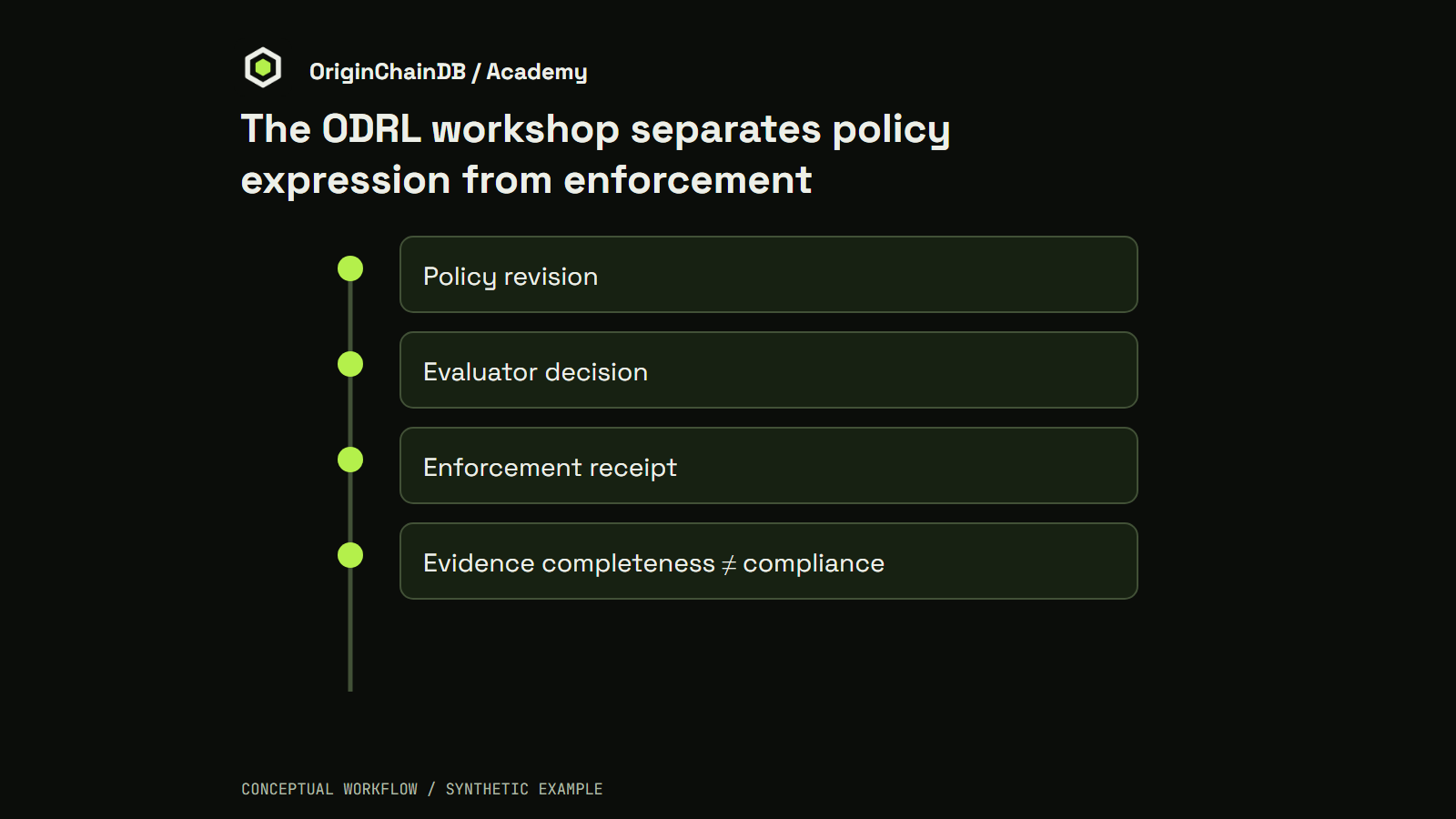
Now imagine the program changes its prerequisite rule midway through an application cycle. A decision made in August should remain explainable in October. Re-evaluating every historical case against today’s policy can erase the reason an earlier decision was reasonable. The application needs a decision record that points to the rule version actually used.
This is a data-design problem around the credential, alongside the cryptographic verification problem inside it. The architecture below is an original OriginChainDB editorial proposal for a prototype. It is not a claim that W3C recommends OriginChainDB, that the database issues or verifies credentials, or that this workflow provides a regulatory certification.
A five-stage workflow an institution can inspect
The first stage is receive. Accept the submitted evidence through the institution’s approved channel. Record an application-scoped reference and avoid copying the entire credential into every operational table. A synthetic demonstration should use fictional learners and clearly marked sample claims.
The second stage is verify. A dedicated, standards-aware verification component performs the checks required by the institution’s chosen credential profile. The database stores an appropriately scoped result and reference to the evidence; it does not replace that verifier merely because it can store JSON or find text.
The third stage is apply policy. Resolve the relevant program, intake and policy version. Check the issuer against the institution’s maintained acceptance rules, then evaluate whether the asserted qualification meets the stated prerequisite. A technically valid credential from an unaccepted issuer should not silently pass this stage.
The fourth stage is review exceptions. Send incomplete, ambiguous or conflicting evidence to a person with the authority to resolve it. The screen should explain which rule needs attention. “Manual review: qualification mapping is not established” is more useful than “AI confidence low.”
The fifth stage is record the decision. Store the outcome, reason, policy version, evidence reference, relevant verification result and decision time. If an authorized reviewer later changes the outcome, record a new decision event with its explanation. Do not make the earlier rationale disappear through an unexplained overwrite.
Where OriginChainDB can fit
An application using OriginChainDB can keep structured operational records for applications, programs and decision events. SQL supports exact lookups and explicit business predicates. Full-text search can help staff locate passages in approved policy documents. Graph relationships can connect application, program and policy records when the application deliberately models those links. Vector retrieval may help discover similar wording, but similarity must not decide eligibility. See the OriginChainDB query-shape guide for the supported interfaces.
Keep the external verification component and the institution’s decision authority visible in the architecture. OriginChainDB is proposed here as the data layer around that workflow. A row saying verified=true is only as useful as the process that produced it, its scope and its freshness.
The separation also improves incident analysis. If a learner’s application is rejected, the team can investigate whether the problem was the submitted evidence, a technical verification result, an issuer rule, a qualification mapping or a human decision. Combining all of these into a single score makes the system much harder to challenge or correct.
Design records around questions, not around a generic document dump
Start with a compact model for a fictional institution. The following table is a proposed application contract, not a W3C schema or an OriginChainDB built-in credential format.
| Record | Question it answers | Illustrative fields |
|---|---|---|
| Application | Which case are we reviewing? | application_id, program_id, intake_id, status |
| Evidence reference | Which submitted material informed the case? | evidence_id, application_id, controlled_location, received_at |
| Verification observation | What did the verifier check, and when? | observation_id, evidence_id, profile_version, result, checked_at |
| Policy revision | Which institutional rule applies? | policy_id, revision, program_id, effective_scope |
| Decision event | Why did the case receive this outcome? | decision_id, application_id, policy_revision, outcome, reason, decided_at |
Do not confuse an operational reference with a globally reusable learner identifier. Use the minimum identity information necessary for the workflow, and establish access and retention rules with the institution’s responsible teams. The prototype should prove that staff can explain a decision without making the learner’s complete history searchable by everyone.
A document fingerprint may help detect whether two stored files have identical bytes, but it is not automatically proof that a credential is valid or that a person is its legitimate holder. Assign every field a narrow meaning. Clear names reduce the chance that another service treats an implementation detail as an assurance claim.
An example: one credential, two different program rules
Consider a fictional learner, Mira, who submits evidence of a training course. Program A accepts that qualification when the issuer is on its approved list. Program B requires an additional practical assessment. The same submitted evidence can support different outcomes without either decision being inconsistent.
For Program A, the application resolves policy A, revision 3, and records an accepted outcome with the required checks. For Program B, it resolves policy B, revision 2, and requests the missing assessment. The reviewer should see the reason attached to each case, not a global “Mira is approved” flag reused everywhere.
If policy B changes next month, the application can identify which cases were decided under revision 2 and which require a new review under the new rule. It should not silently rewrite the history of a completed admission decision. A controlled re-evaluation is a new workflow, with its own scope and owner.
This example illustrates why relational identifiers and revision links remain useful even when the incoming evidence is cryptographically secured. The institution needs to explain its own actions, not only retain a copy of what it received.
Where a generative AI assistant helps—and where it should stop
A staff assistant could retrieve an approved prerequisite policy and draft a plain-language explanation of the next required step. Its answer should identify the policy revision and cite the passage actually used. Staff should be able to open the source from the application rather than trust a plausible paraphrase.
The assistant should not infer eligibility from the nearest policy paragraph or an embedding similarity score. It should not invent an issuer’s accreditation, treat text inside a submitted credential as an instruction, or make an irreversible admissions change merely because the generated explanation sounds confident.
Give the assistant a restricted evidence view assembled by the application. If the case requires a human exception decision, make that state explicit in the user interface. A useful assistant reduces reading and navigation effort while leaving the decision rule and the responsible authority understandable.
What to test in a first pilot
Use fictional cases before connecting sensitive learner data. Include an accepted issuer, an issuer not on the accepted list, incomplete evidence, a changed policy revision and two programs with different requirements. Include a record the test reviewer is not permitted to access. These cases test the workflow’s boundaries rather than just its happy path.
Measure whether each decision has a recoverable explanation. Can a reviewer identify the evidence and rule version? Can the team reproduce why the case was routed for manual review? Can an authorized correction be recorded without losing the previous event? Can a user see only the cases assigned to their role?
Track operational measures separately from accuracy claims: unresolved-case age, missing evidence frequency, review turnaround and the share of decisions lacking a policy reference. Do not announce reduced fraud, higher acceptance accuracy or standards conformance from a small architecture demonstration. Those conclusions require their own evidence.
Questions education teams should ask now
Is the September 2026 v2.1 document a final standard?
No. It is a W3C Working Draft. Treat implementation against it as a deliberate version choice and monitor changes. The dated source makes the version being discussed explicit.
Can OriginChainDB verify a digital credential’s signature?
This proposal does not use OriginChainDB as the cryptographic verifier. A separate credential-verification component supplies observations that the application can store and use alongside its policy rules.
Does a valid credential automatically satisfy an admission requirement?
No. Technical verification and institutional acceptance are different stages. The receiving program determines which evidence and issuer relationships it accepts for the stated purpose.
What is the smallest useful first project?
Build a synthetic application register with versioned policies, evidence references and explainable decision events. Prove that two programs can apply different rules to the same evidence without losing the rationale or exposing unrelated cases.
The practical next step
The standards development is a reason to review the whole evidence journey, not only the credential viewer. Begin with one program, one clearly owned policy and a small set of fictional cases. Keep verification, policy evaluation, human review and decision history separate enough that a person can inspect each stage.
For a data-layer prototype, start with the OriginChainDB documentation and its schema guide. Read the dated W3C draft alongside the v2.0 Recommendation before choosing a credential profile. The useful outcome is a system that can explain both the evidence it received and the decision the institution made.