Pick up the work.
Store checkpoints, current status and run identifiers so the runtime can load the state it needs for its next step.
AI agents
Keep run state, useful memories and tool outcomes in one database. Retrieve the context your agent needs and inspect the records behind its work.
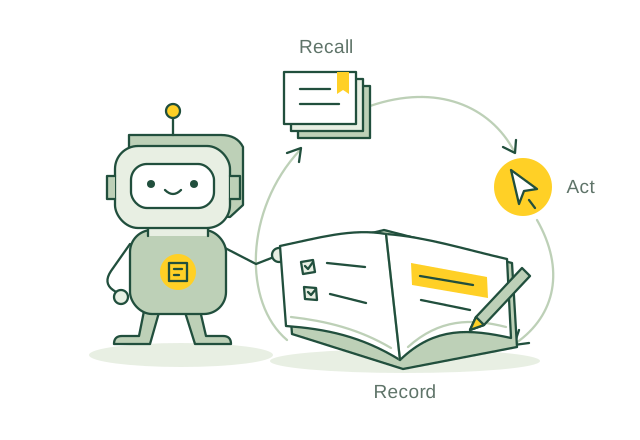
Keep task history and source records within reach of your agent.
Illustrative applicationWhat you can build
Store checkpoints, current status and run identifiers so the runtime can load the state it needs for its next step.
Retrieve related memories by meaning, or find a specific observation by its words and structured fields.
Connect observations and tool events to their originating run and source records using stable identifiers.
The application workflow
Your runtime controls the agent loop. The database holds the state and evidence the runtime reads and writes along the way.
memory_id agent_id session_id observation source_id Your schema, built around your application.
Read run state and retrieve relevant memories. Resolve the returned IDs to source records before preparing the next prompt.
The application calls models and tools, checks permissions and obtains approval where the workflow requires it.
Write tool events, new observations and the updated run state. Track separate vector or text-index writes before treating a memory as ready for retrieval.
How it fits together
 OriginChainDB
Stores runs, memories, events and declared relationships. Provides structured lookup, similarity and keyword retrieval for the context your runtime needs.
Chooses tools, calls models, manages retries and decides when to act. Carries agent and session scope into every request.
ASK can serve as a scoped query tool that returns database rows and an executed plan. It does not orchestrate an agent or approve external actions.
Build for real use
Use stable run, memory and tool-call IDs. Make retries explicit so retrying storage work does not repeat an external action.
Coordinate removal of the source row and application-managed vector or text entries. Define which representations exist and track each removal.
Apply database access controls and validate agent/session scope in the service. Retrieval metadata filters help narrow results but do not replace authorization.
Build with OriginChainDB