
SQL · Find the facts
The question
Which policy covered this vehicle on the loss date?
Select the claim, loss date and policy version.
Explore SQLInsurance
Retrieve the policy in force, relevant clauses and supporting documents for a claim. Help handlers identify what is missing before reviewing coverage.
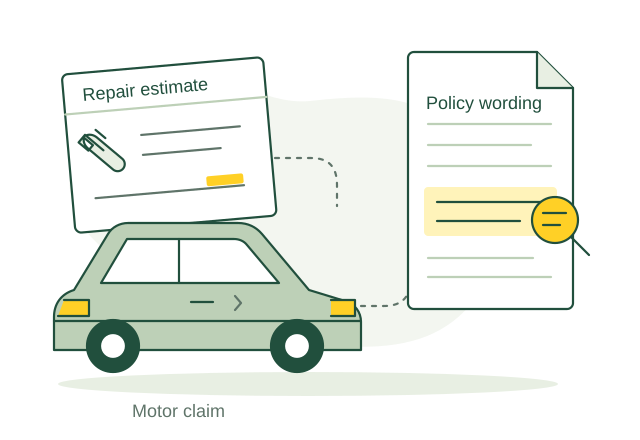
Find repair evidence and the policy terms for a motor claim.
Illustrative use case01 / Use case guide
Compare the data models behind everyday industry tasks, from finding records to following connections.
Suggested model combination
Scroll across to compare all four models| Use case | How the data models help | SQL | Vector | Graph | Full-text | Source |
|---|---|---|---|---|---|---|
| Claims coverage evidence review Find the policy wording and endorsements relevant to a reported loss. | Use SQL to select the policy version on the loss date and Full-text to locate exact clauses for the handler. | SQL included | Vector not needed for this example | Graph not needed for this example | Full-text included | |
| Claims intake document routing Associate incoming evidence with the correct claim and policy. | Use SQL to filter open claims, Graph to follow recorded claim–policy links, and Full-text to locate supplied claim references. | SQL included | Vector not needed for this example | Graph included | Full-text included | |
| Medical claim document review Find relevant passages across a claim's medical documents. | Use SQL to scope the claim and document dates, Vector to retrieve related descriptions, and Full-text to find exact medical terms. | SQL included | Vector included | Graph not needed for this example | Full-text included | |
| Underwriting submission evidence review Bring exposure data, loss histories and risk reports into an underwriter's review. | Use SQL to select submission records, Vector to retrieve related risk narratives, and Full-text to locate exact loss references. | SQL included | Vector included | Graph not needed for this example | Full-text included | |
| Connected claims investigation support Examine recurring parties across claims referred for investigation. | Use SQL to scope referred claims by date and Graph to trace documented claimant, vehicle and provider connections for investigators. | SQL included | Vector not needed for this example | Graph included | Full-text not needed for this example | |
| Delegated risk data checks Investigate missing or inconsistent fields in coverholder risk reports. | Use SQL to surface missing fields and duplicate references, and Full-text to find the corresponding binder wording for review. | SQL included | Vector not needed for this example | Graph not needed for this example | Full-text included | |
| Premium bordereau reconciliation Trace premium reporting discrepancies to the relevant binder and reporting party. | Use SQL to compare reported premium records by period and Graph to trace their binder, coverholder and managing-agent relationships. | SQL included | Vector not needed for this example | Graph included | Full-text not needed for this example | |
| Delegated claims authority review Verify the administrator's recorded appointment before routing a claim. | Use SQL to filter appointment records, Graph to follow administrator–managing-agent relationships, and Full-text to retrieve the documented scope of authority. | SQL included | Vector not needed for this example | Graph included | Full-text included | |
| Catastrophe forecast evidence checks Explain differences between catastrophe forecast returns and supporting scenarios. | Use SQL to compare reported snapshots, Graph to connect returns to supplied model-run records, and Full-text to retrieve scenario assumptions. | SQL included | Vector not needed for this example | Graph included | Full-text included | |
| Catastrophe loss reporting support Assemble claims associated with a named catastrophe for reporting review. | Use SQL to select reporting periods, Graph to follow recorded claim–event links, and Full-text to find the catastrophe's official description. | SQL included | Vector not needed for this example | Graph included | Full-text included |
Use the query interfaces you need, then connect their results through shared record IDs in your application.
These sources describe real industry workflows. The model combinations above are proposed OriginChainDB designs, not customer deployment claims.
02 / A closer look
A repair estimate arrives after a claim has been opened. The handler must check the policy version in force, find the relevant clause and identify which evidence is still missing before making a decision.
Policy wording and endorsements live in separate files.
The same damage is described differently in each document.
An incomplete evidence pack causes another follow-up.
Use the loss date to select the applicable policy. Search its clauses and linked claim documents, then show missing evidence to the handler.
03 / Queries
Select a model to see the question it answers.
The question
Select the claim, loss date and policy version.
Explore SQLThe question
Retrieve similar descriptions from approved claim documents.
Explore VectorThe question
Follow declared links between claim, policy, vehicle and repairer.
Explore GraphThe question
Locate exact clause names, reference numbers and terms.
Explore Full-textUse shared record IDs to combine results from the different query interfaces in your application.
04 / Implementation
Use authorized closed claims with unnecessary personal data removed. Have handlers identify the documents and clauses required for each review.
Assign claim, policy and passage IDs. Store effective dates and file references. Your ingestion pipeline extracts text and maintains search indexes and embeddings.
Filter by access and policy dates. Search relevant wording and follow document links. Show the source passages and missing inputs in the handler’s screen.
Check policy versions, missing evidence and incorrect matches against closed cases. Pilot with handlers while keeping claim decisions in the existing approval process.
05 / Testing
Compare these results with your current process before rollout.
Compare the retrieved pack with the documents handlers marked as required.
Check whether each cited clause belongs to the policy effective on the loss date.
Compare time spent finding evidence against the existing workflow, without assuming a saving.
06 / Sources
Published projects and reference material relevant to this use case.
Allianz
Allianz describes an Insurance Copilot launched for automotive claims in Austria, helping adjusters ask questions and navigate case information.
Read the sourceZurich Insurance
Zurich identifies medical document intelligence and automated claims intake among its insurance AI use cases, alongside responsible AI practices.
Read the sourceThese are industry references, not OriginChainDB customer stories. The implementation above is a proposed example.
Build with OriginChainDB