On 9 September 2026, NIST announced the final version of IR 8536, Supply Chain Traceability Principles: A Manufacturing Meta-Framework. Its announcement describes an industry-neutral approach to exchanging and verifying traceability information while continuing to use existing industry standards. Read the NIST announcement.
For manufacturing teams, this development brings attention to a familiar operational problem: a part may move between organizations faster than the evidence explaining its origin, inspection or revision. A record of movement and evidence supporting a claim are related, but they are not interchangeable.
Start with one question a person can verify
Imagine a fictional component lot arriving at a factory. The receiving team wants to find its supplier, the applicable inspection document and the document’s revision. If the lot identifier is ambiguous, a text search for a similar name is not enough. If a document is present but its source is unknown, storing it does not establish authenticity.
A useful pilot therefore separates identity, relationships and evidence. Record a stable lot ID. Link it to the supplier record used by the application. Preserve the evidence document’s source and revision. Keep a clear distinction between information received from a supplier and a claim independently verified by the receiving organization.
An OriginChainDB application pattern
OriginChainDB’s SQL records can represent structured attributes such as lot ID and inspection status. Declared graph relations can model supported connections to suppliers or documents. FTS can help engineers locate a specific term in approved documentation. Vector retrieval can be evaluated for broader questions about related guidance.
This is a proposed architecture using database modalities, not a claim that OriginChainDB implements IR 8536 or verifies supply-chain claims automatically. Signature verification, partner trust, interchange formats and governance require their own validated components and processes.
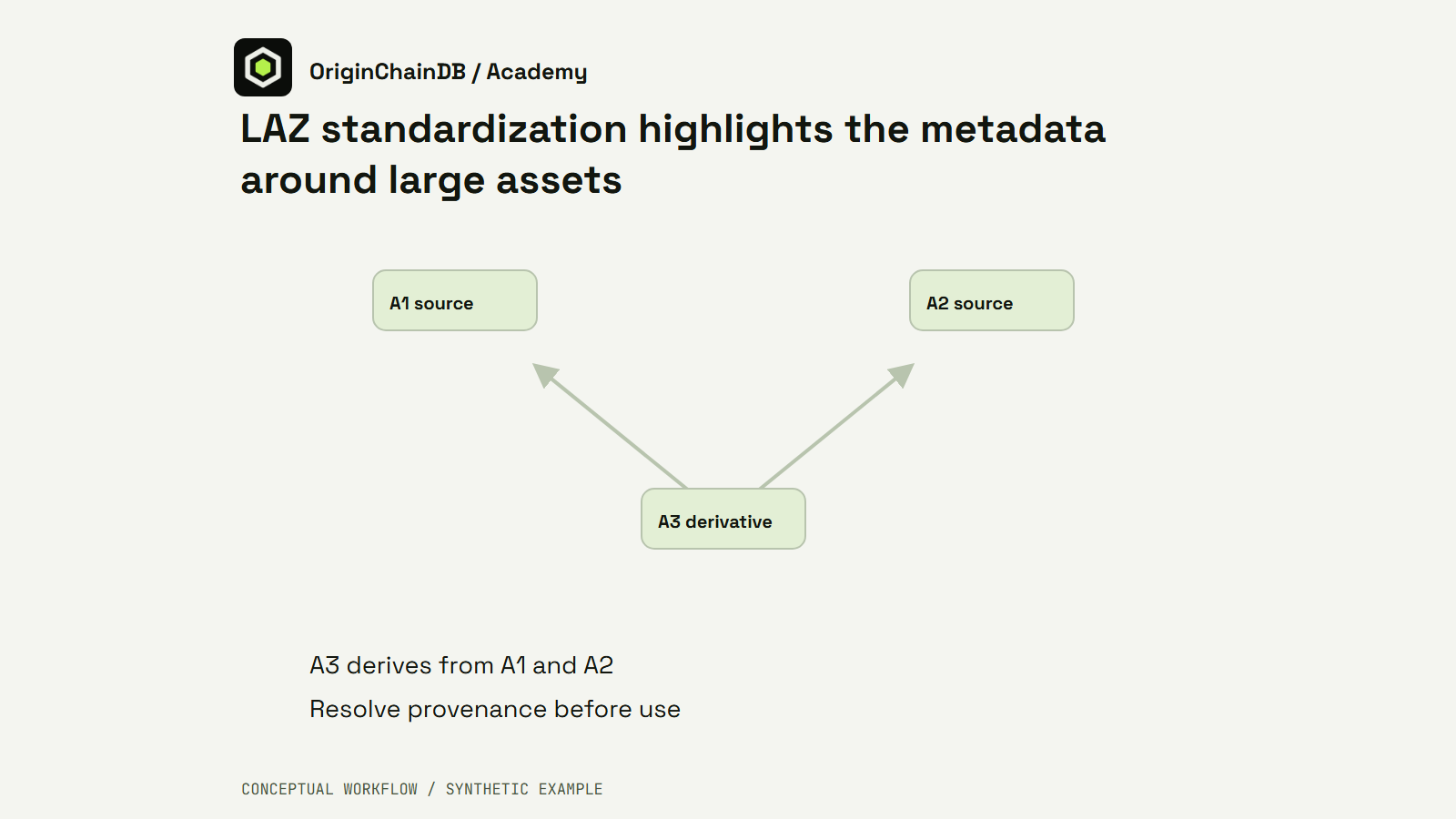
When search produces a document ID, resolve it to the current source record and show the revision. Avoid presenting a nearest text match as proof that a component passed inspection. The application must know what the evidence actually says and whether it applies to this lot.
Test the handoffs, including the bad ones
Use a small synthetic dataset containing a valid lot, a missing supplier reference, an outdated document and two similarly named components with different IDs. The first case should produce an understandable evidence trail. The others should surface the missing or conflicting information instead of quietly selecting the most convenient match.
Change a document revision and repeat the lookup. Confirm that both the structured record and any search representation are updated through the chosen ingestion workflow. Preserve the previous revision where your retention policy requires it, without presenting it as the current instruction.
Measure whether the team can identify which source supports each answer. An attractive diagram is not enough if the links behind it cannot be resolved. Add response-time measurements after the identity and evidence checks pass.
The practical opportunity
Connected records can help a manufacturing team investigate questions with less manual searching, but that benefit must be demonstrated in the pilot. Begin with one evidence path and expand only after it behaves predictably across updates and missing data.
Use the OriginChainDB graph schema guide and FTS reference to explore the storage and retrieval pieces. Recheck NIST’s project materials when preparing an implementation; the article reports the dated final-publication announcement, not an unverified current status for its reference software.