What changed
The PostgreSQL Global Development Group announced PostgreSQL 19 Beta 4 on September 24. It is a beta release; its announcement should not be read as a production-upgrade recommendation. Read the official release notice.
Our reading
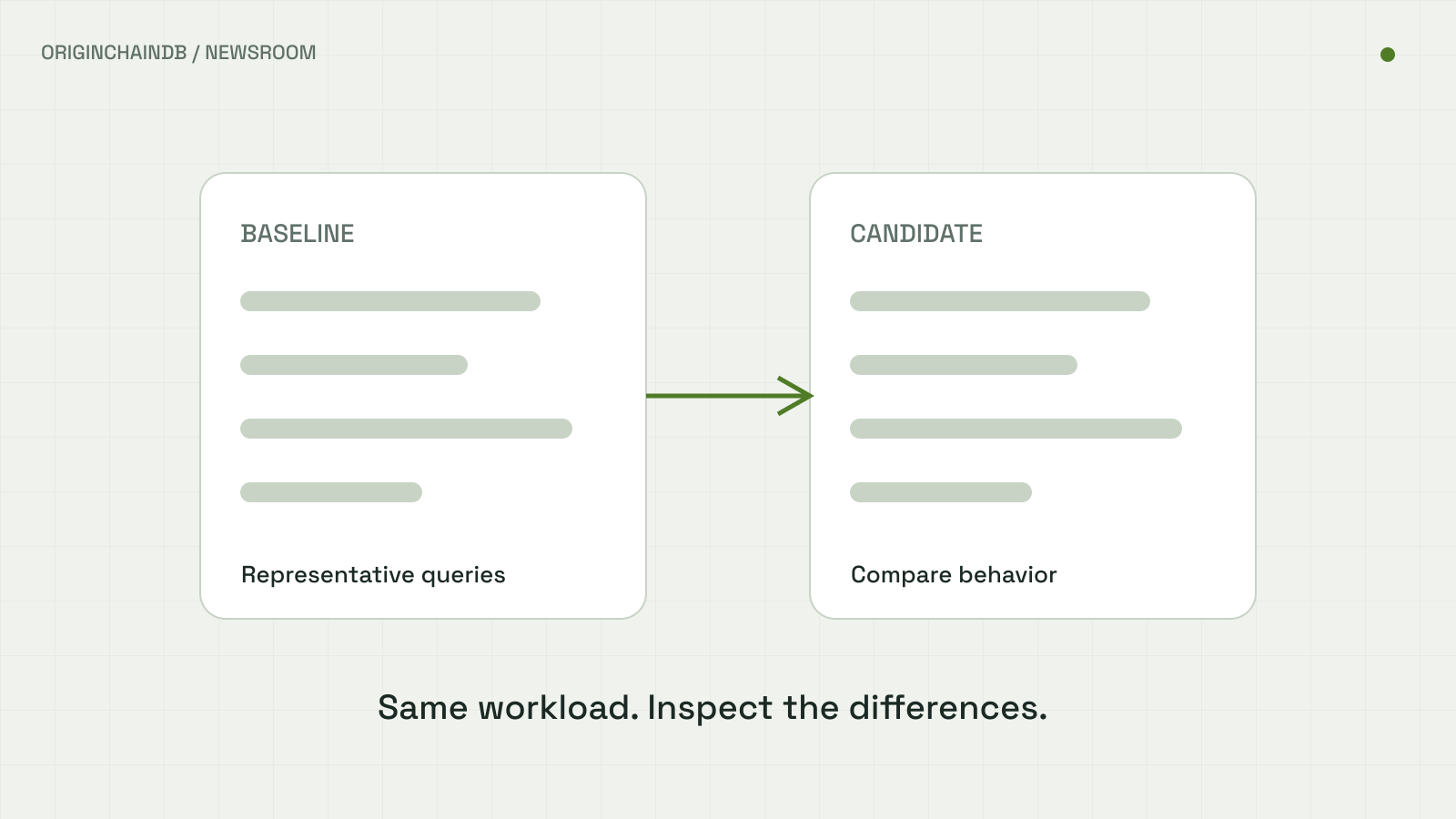
A release milestone is a useful prompt to improve your own test corpus. Collect the queries your application actually runs, including filters, joins, pagination and error cases. Record expected results before looking at performance.
Then compare application-level latency using equivalent datasets and connection behavior. A fast query measured inside a database is not the same measurement as a request that includes networking and serialization.
Make the results reusable
Save the database version, schema, query parameters and test conditions with each result. That record is useful for future upgrades and for evaluating a different database.
OriginChainDB is a separate database engine. Client-protocol compatibility does not imply complete PostgreSQL feature compatibility. Start with the SQL documentation when evaluating a workload.